Berlin’s complex World War II history is etched into its streets, monuments, and memorials. For history lovers traveling on a budget, the city offers a wealth of meaningful and educational experiences—completely free of charge. From poignant memorials to lesser-known historic structures, this guide highlights the top WWII-related sites in Berlin that you can visit without spending a euro.
1. Topography of Terror
Once the nerve center of Nazi operations, this site now hosts a powerful open-air and indoor documentation center. The Topography of Terror traces the brutal machinery of the SS and Gestapo through well-researched exhibits, photos, and chilling remains of the Berlin Wall.
📍Niederkirchnerstraße 8, 10963 Berlin- 🕓 Open daily: 10:00 AM – 8:00 PM
- 💲 Free admission
- https://www.topographie.de/en/
2. Memorial to the Murdered Jews of Europe (Holocaust Memorial)
One of Berlin’s most iconic memorials, this field of towering concrete stelae invites silent reflection on the Holocaust. Beneath the surface, an underground information center explores the stories of victims through letters, photos, and biographies.
📍Cora-Berliner-Straße 1, 10117 Berlin- 🕓 Memorial open 24/7; Info Center Tue–Sun, 10:00 AM – 6:00 PM
- 💲 Free admission
- https://www.visitberlin.de/en/memorial-murdered-jews-europe
3. Führerbunker Site
Though the original Führerbunker is sealed and unrecognizable today, a small sign now marks this infamous location. Located in a residential courtyard near Potsdamer Platz, it’s a stark reminder of the regime’s end.
📍Gertrud-Kolmar-Straße 14, 10117 Berlin- 🕓 Accessible 24/7
- 💲 Free and outdoors
4. Anhalter Bahnhof Ruins
These haunting ruins of a WWII-era train station serve as a memorial to the Berlin Jews deported to concentration camps. Only the front façade remains, but its historical weight is deeply felt.
📍Askanischer Platz, 10963 Berlin- 🕓 Open 24/7
- 💲 Free and outdoors
5. Visit the Documentation Center for Displacement, Expulsion, and Reconciliation
Located near Anhalter Bahnhof, this modern and moving museum explores the fates of millions of people displaced during and after WWII — with a special focus on the German expellees from Central and Eastern Europe. Through personal stories, interactive exhibits, and rare historical materials, it offers a deeply human perspective on the consequences of war, nationalism, and forced migration.
📍Stresemannstraße 90, 10963 Berlin- 🕓 Tuesday–Sunday, 10:00 AM – 7:00 PM (Closed Mondays)
- 💲 Free admission
- https://www.museumsportal-berlin.de/en/museums/dokumentationszentrum-flucht-vertreibung-versoehnung/
6. German-Russian Museum Berlin-Karlshorst
Located in the very building where the Nazi unconditional surrender to the USSR was signed in 1945, this museum provides fascinating insight into the war on the Eastern Front. Exhibits include military gear, personal accounts, and Soviet-German wartime relations.
📍Zwieseler Str. 4, 10318 Berlin- 🕓 Tue–Sun, 10:00 AM – 6:00 PM
- 💲 Free admission
- https://www.museum-karlshorst.de/en/
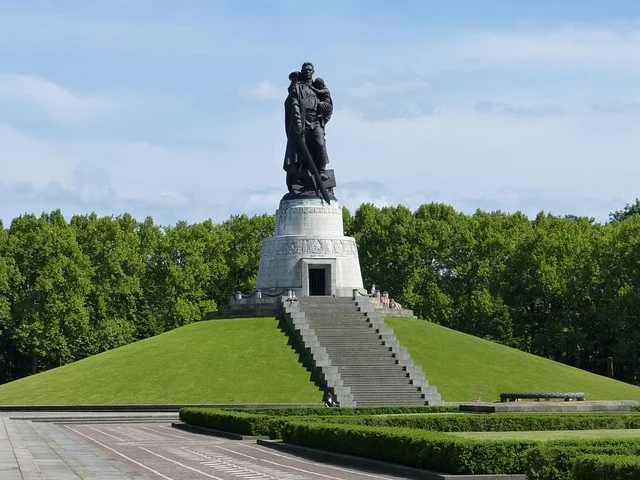
7. Soviet War Memorial in Treptower Park
One of the largest Soviet war memorials outside Russia, this vast park commemorates 7,000 Red Army soldiers who died during the Battle of Berlin. The centerpiece is a 12-meter statue of a soldier holding a child and crushing a swastika.
📍Puschkinallee, 12435 Berlin- 🕓 Open 24/7
- 💲 Free and outdoors
- https://www.visitberlin.de/en/soviet-memorial-treptow
8. See the Soviet War Memorial in Tiergarten
Erected shortly after the end of WWII in 1945, the Soviet War Memorial in Tiergarten honors the Soviet soldiers who died during the Battle of Berlin. Located along Straße des 17. Juni, just a short walk from the Brandenburg Gate, the memorial features two Soviet tanks and artillery pieces, along with a massive central statue and colonnade.
📍Straße des 17. Juni, 10557 Berlin (Tiergarten Park)- 🕓 Open 24/7 (outdoor monument)
- 💲 Free to visit
- https://www.berlin.de/sen/uvk/en/nature-and-green/urban-green-space/cemeteries-and-other-burial-sites/soviet-memorials/tiergarten/
9. Stumbling Stones (Stolpersteine)
Scattered across Berlin’s sidewalks, Stolpersteine (“stumbling stones”) are small brass plaques embedded in the pavement in front of homes from which victims of Nazi persecution were taken. Each one bears a name and story, turning Berlin into an open-air memorial.
📍Various locations citywide- 🕓 Accessible 24/7
- https://www.stolpersteine-berlin.de/en
10. Reichstag Building and Its WWII Scars
The Reichstag, today home to the German Parliament, was severely damaged during WWII. While mostly restored, it still bears graffiti left by Soviet soldiers in 1945.
📍Platz der Republik 1, 11011 Berlin- https://www.bundestag.de/en/visittheBundestag/dome/
11. Sachsenhausen Concentration Camp Memorial
Just outside Berlin in Oranienburg, Sachsenhausen was one of the first Nazi concentration camps and later used by the Soviets. Today, it stands as a sobering reminder of the atrocities committed and a tribute to the victims.
📍Str. der Nationen 22, 16515 Oranienburg- 🕓 Daily, 8:30 AM – 6:00 PM (Apr–Oct), until 4:30 PM (Nov–Mar)
- 💲 Free admission; audio guides and tours available
- https://www.sachsenhausen-sbg.de/en/
12. Gleis 17 Memorial at Grunewald Station
A solemn installation along Platform 17: bronze plates mark the dates and destinations of deportations sent from this station to Nazi camps. It honors those whose journey to extermination began here.
📍Hindenburgdamm (Platform 17), Grunewald S‑Bahn Station- 🕓 Accessible 24/7
- 💲 Free and outdoors
- https://www.berlin.de/en/attractions-and-sights/4193712-3104052-platform-17-memorial.en.html
13. Visit the Schwerbelastungskörper – Nazi-Era Concrete Test Structure
One of Berlin’s more obscure but fascinating WWII-related sites, the Schwerbelastungskörper (“Heavy Load-Bearing Body”) is a massive concrete cylinder built in 1941 to test whether Berlin’s marshy ground could support Adolf Hitler’s megalomaniacal building plans for the capital, known as Germania. The test structure was meant to simulate the weight of a triumphal arch that was never built.
📍General-Pape-Strasse 34A, 12101 Berlin- 🕓 1st April 2025 until 31t October, Tuesday, Wednesday, Thursday, Saturday and Sunday, 1 – 6 pm
- 💲 Free
- https://www.schwerbelastungskoerper.de/the-information-center.html
14. Weißensee Jewish Cemetery Stones
At this large Jewish cemetery, bombed during WWII, you’ll find numerous fallen headstones and memorial stones acknowledging desecration and loss. It’s a powerful place to reflect on the community that was decimated.
📍Am weißen See 30–40, 13088 Berlin- 🕓 Typically open during daylight hours
- 💲 Free entry
15. See the Former Reich Ministry of Aviation Building
This imposing stone structure was once the headquarters of the Reich Ministry of Aviation, led by Hermann Göring. Constructed in record time between 1935–1936, the building housed over 2,000 offices and became the administrative heart of Nazi Germany’s air force. Remarkably, it survived WWII almost entirely intact and remains one of the largest office buildings in Berlin. While it’s not open for general interior tours, visitors can admire its massive façade and learn about its history from interpretive signage outside.
- 📍 Wilhelmstraße 97, 10117 Berlin (now houses the German Finance Ministry)
- 🕒 Exterior viewable any time; no entry for public tours
16. Visit the Kaiser Wilhelm Memorial Church (Gedächtniskirche)
One of Berlin’s most iconic landmarks, the Kaiser Wilhelm Memorial Church stands as a powerful symbol of the destruction caused by World War II. Badly damaged during a 1943 air raid, the church’s ruined spire was deliberately left standing as a memorial against war and a call for peace. Visitors can enter the preserved ruins and small exhibition inside to learn about its wartime history and postwar reconstruction efforts.
- 📍 Breitscheidplatz, 10789 Berlin
- 🕒 Daily, typically 10:00–18:00 (times may vary slightly by season or service schedule)
- 💲 Free entry to memorial hall and exhibition
- https://www.visitberlin.de/en/kaiser-wilhelm-memorial-church
17. Learn About Resistance at the Silent Heroes Memorial Center
Tucked away in a quiet courtyard in Berlin-Mitte, the Silent Heroes Memorial Center honors those who resisted the Nazi regime by helping persecuted Jews. Through personal stories, letters, photographs, and documents, the museum highlights the courage of these individuals—both Jews who lived in hiding and the people who risked their lives to protect them. It offers a sobering, human-centered perspective on resistance during WWII.
- 📍 Stauffenbergstraße 13-14, 10785 Berlin (inside the German Resistance Memorial Center complex)
- 🕒 Open daily, 10:00–18:00 (closed on public holidays)
- 💲 Free entry
- https://www.museumsportal-berlin.de/en/museums/gedenkstaette-stille-helden/
18. Explore Aviation History at the Luftwaffenmuseum der Bundeswehr
Located just outside Berlin at the former RAF Gatow airfield, the Luftwaffenmuseum der Bundeswehr (German Air Force Museum) offers a fascinating and extensive collection of military aircraft, artifacts, and documents tracing the history of German aviation. Several aircraft from the WWII era are on display, alongside Cold War-era jets and detailed exhibitions about the development of the Luftwaffe. The open-air layout and hangars make it an ideal stop for aviation enthusiasts and history lovers alike.
- 📍 Am Flugplatz Gatow 33, 14089 Berlin (district of Kladow)
- 🕒 Open Tuesday–Sunday, 10:00–18:00 (closed Mondays)
- 💲 Free entry
- https://www.mhm-gatow.de/de
19. Visit the Jewish Museum Berlin
Designed by Daniel Libeskind, the Jewish Museum Berlin is both a striking architectural landmark and a deeply moving historical narrative. While temporary exhibitions require a fee, you can experience the permanent exhibition of Jewish culture, the Holocaust Tower, Garden of Exile, and more—completely free.
- 📍 Location: Lindenstraße 9–14, 10969 Berlin (Kreuzberg)
- 🕒 Opening Hours: Daily 10:00 AM – 6:00 PM (last entry at 5 PM)
- 💲 Admission: Core exhibition always free; temporary exhibits €10
- https://www.jmberlin.de/en
Conclusion
Berlin proves that you don’t need a ticket to experience powerful history. These free WWII sites offer meaningful engagement with the past—from grand monuments to subtle sidewalk markers. Whether you’re on a short visit or an extended stay, these locations ensure your journey through Berlin is rich in both remembrance and insight—without spending a single euro.
Related Posts:
Berlin on a Budget: Top Free Things to Do in the German Capital